
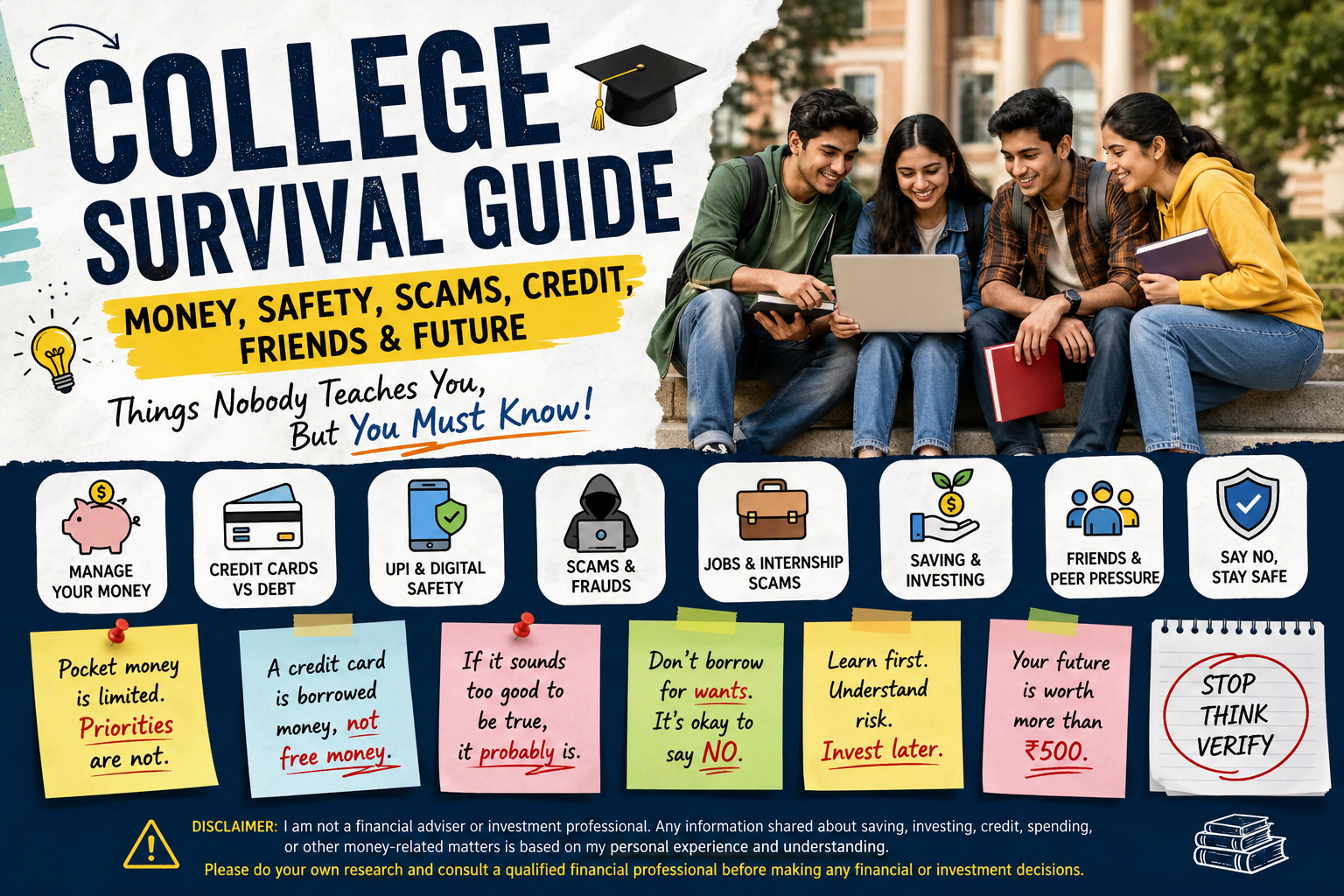
Things Nobody Teaches You When You Start College
Starting college is exciting.
For many students, it is the first time they experience a completely new level of independence. You meet new people, make new friends, attend new classes, explore new places and start making many decisions on your own.
But with freedom comes responsibility.
College is not only about attending classes, completing assignments and earning a degree. It is also the time when you start learning how to manage money, choose your friends, deal with peer pressure, protect your personal information, understand credit and debt, recognize scams and make decisions that can affect your future.
Many of these lessons are not taught in classrooms.
This is why every student should have a basic College Survival Guide — not just for academic success, but for everyday life.
College is your training ground for life. Learn to manage your money, choose your people wisely and protect yourself.
1. Welcome to College: Freedom Comes With Responsibility
College gives you more freedom than school.
You may decide where to go, who to spend time with, what to buy, which opportunities to explore and how to spend your free time.
That freedom is exciting, but it also comes with responsibility.
Your parents may not know every decision you make. Your teachers cannot monitor everything you do. Your friends may encourage you to do things that are good for you — or things that are not.
Nobody will stop you from making every bad decision.
That means you need to learn how to recognize a bad decision before making it.
College is therefore a good time to develop five important skills:
- Money management
- People and relationships
- Digital safety
- Credit and debt awareness
- Future planning
Your degree is important, but these skills will also stay with you long after college.
2. Your Pocket Money Needs a Plan
For many students, college is the first time they receive regular pocket money.
Maybe you receive ₹3,000, ₹5,000, ₹10,000 or more every month.
The amount is not the most important thing.
The important question is:
What do you do with the money you receive?
A common mistake is:
Receive → Spend → Finish → Ask for more
A better approach is:
Receive → Divide → Spend → Save
For example, imagine you receive ₹5,000 every month.
You could divide it according to your own situation:
- ₹2,000 — Essentials
- ₹1,000 — Fun
- ₹1,000 — Savings
- ₹500 — Emergency
- ₹500 — Learning
These numbers are only an example. Every student’s situation is different.
The real lesson is to make a plan before your money disappears.
Saving even a small amount every month can help you develop a habit that becomes extremely valuable when you eventually start earning.
3. Learn the Difference Between Needs and Wants
One of the simplest financial skills is also one of the most important:
Know the difference between something you need and something you want.
Needs
These may include:
- Food
- Transportation
- College supplies
- Phone recharge
- Required study material
- Basic personal-care items
Wants
These may include:
- The latest smartphone
- Expensive headphones
- New shoes because your friend bought them
- Eating out every day
- Gaming purchases
- Random online shopping
Wanting something is not wrong.
You are allowed to enjoy your money.
The problem begins when you repeatedly spend money on things you don’t really need and then don’t have enough money for things that actually matter.
Before buying something, ask yourself:
“Do I need this, or do I just want this?”
That one question can prevent a lot of unnecessary spending.
4. The ₹100 Problem
Students often don’t notice small expenses.
₹50 here.
₹100 there.
₹150 at a café.
₹200 for food delivery.
₹100 for something online.
Each individual expense may not feel important.
But repeated spending adds up.
For example:
₹100 × 25 days = ₹2,500
That is ₹2,500 that could have gone toward savings, education, an emergency fund or something you actually needed.
This is why you should try an experiment:
Track every rupee you spend for seven days.
Write down everything:
- Tea
- Coffee
- Snacks
- Food delivery
- Auto/cab
- Gaming
- Subscriptions
- Shopping
- Entertainment
At the end of seven days, look at the total.
You may be surprised where your money actually goes.
5. Use the 24-Hour Rule Before Buying
College students are constantly exposed to advertisements, influencers, social media trends and friends showing off new products.
This can create impulse purchases.
You see something.
You want it.
You buy it.
Later, you wonder:
“Why did I buy this?”
A simple habit can help:
The 24-Hour Rule
If something is not essential, don’t buy it immediately.
Wait 24 hours.
Then ask:
- Do I really need it?
- Can I afford it?
- Will I still want it tomorrow?
- Do I have something similar already?
For expensive purchases, give yourself even more time.
Impulse wants speed. Good decisions need time.
6. What Should a Fresher Actually Buy?
When students enter college, there can be pressure to buy new things.
A new phone.
New clothes.
New shoes.
Headphones.
Smartwatch.
Laptop.
Accessories.
But you don’t need to buy everything at once.
Start with what you genuinely need for college.
This may include:
- A reliable backpack
- Stationery
- Required academic material
- Basic clothing
- Personal-care essentials
- Useful charging accessories
- Anything genuinely required for your studies
Then think carefully before buying expensive gadgets and accessories.
Just because your friend owns something does not mean you need it.
You don’t have to own everything you see.
7. Don’t Buy Your Lifestyle on EMI
EMIs can make expensive products look affordable.
You may see an advertisement saying:
“Only ₹3,000 per month!”
That sounds much easier than hearing:
“Pay ₹60,000.”
But you need to look at the complete cost.
For example:
Phone price: ₹60,000
If you pay:
₹3,000 × 24 months = ₹72,000
You would be paying ₹12,000 more than ₹60,000 in this example.
The actual cost of an EMI purchase depends on the financing terms, interest and fees.
The important lesson is:
EMI is not a discount.
It is simply a way of paying over time.
Before taking an EMI, ask:
“Can I actually afford this?”
Don’t use EMI simply because the monthly payment looks small.
8. Protect Your UPI and Bank Account
Digital payments have made life extremely convenient.
But convenience also means that students need to understand basic digital security.
There are certain things you should never casually share with anyone.
Never share:
- OTP
- UPI PIN
- ATM PIN
- CVV
- Banking passwords
- Login credentials
It doesn’t matter whether the person is a stranger, classmate, senior or even someone claiming to be from a company.
Your financial credentials are private.
You should also be careful with:
- Unknown links
- Unexpected payment requests
- Unknown QR codes
- Screen-sharing requests
- Unknown calls and messages
- Fake customer-care numbers
One particularly important point for students to understand is:
You generally do not need to enter your UPI PIN to receive money.
When something involving your money feels unusual:
STOP • THINK • VERIFY
9. Could You Fall for a College Scam?
Scams don’t always look like scams.
Sometimes they come disguised as help, opportunities, discounts, scholarships, jobs or requests from people you know.
Consider this example:
“Bro, scan this QR code. I’ll send you ₹500.”
Would you immediately scan it?
Instead of automatically trusting the request, stop and understand what you are actually being asked to do.
Another example:
“Give me your OTP. It’s required to activate your scholarship.”
Would you share it?
The answer should be no.
A scholarship, job, internship or other opportunity should never become an excuse to ignore basic financial and digital safety.
When someone asks you to share an OTP, PIN, password or other sensitive information:
Stop. Verify independently.
10. Fake Internship and Job Scams
College students are actively looking for internships, part-time jobs and career opportunities.
Scammers know this.
Imagine receiving a message:
Congratulations! You have been selected for a ₹30,000/month internship.
Then they ask:
Registration Fee: ₹2,000
This should immediately make you stop and investigate.
Be careful when an opportunity includes:
- A payment before the opportunity begins
- Guaranteed income
- Urgent payment requests
- Unknown companies
- Personal bank accounts
- Suspicious websites
- Pressure to act immediately
- Requests for unnecessary personal information
Before paying or sharing information, independently verify the company and the opportunity.
Don’t rely only on a WhatsApp message, screenshot or phone call.
A good opportunity should not require you to ignore common sense.
11. Scams Can Come From People You Know
One of the most important lessons for college students is that scams don’t always come from strangers.
They can come from:
- Seniors
- Classmates
- Friends
- Acquaintances
- Online contacts
- Strangers
This does not mean you should distrust everyone.
Instead:
Trust people — but verify important things.
You might hear:
“Bro, pay for me. I’ll return it tomorrow.”
Or:
“Everyone is contributing ₹500.”
Or:
“Give me your bank account. I need to receive a payment.”
Or:
“Invest ₹10,000. I’ll double it.”
Or:
“Just share your OTP. It’s only for verification.”
You don’t need to be rude.
You simply need to protect yourself.
And remember:
A genuine friend will respect your NO.
12. Learn to Say NO
Many students find it difficult to say no.
They worry:
“What will my friends think?”
“Will they get angry?”
“Will they think I’m cheap?”
“Will I lose the friendship?”
This is where peer pressure can become dangerous.
You don’t need to provide a long explanation every time.
You can simply say:
“Sorry, I can’t lend money.”
If someone asks for your OTP:
“No. I never share that.”
If someone pressures you to buy something:
“I’ll think about it first.”
If someone offers you an investment:
“I’ll verify it independently.”
If someone makes you uncomfortable:
“I’m not comfortable with that.”
And remember:
NO IS A COMPLETE ANSWER.
You don’t need to feel guilty for protecting yourself.
13. The “I’ll Pay, You Can Return It Later” Trap
This is something students commonly encounter.
Imagine a friend invites you on a trip.
You don’t have enough money.
Your friend says:
“Don’t worry. I’ll pay. You can return it later.”
You agree.
You enjoy the trip.
But when you return, you still don’t have the money to pay your friend back.
Now something that was simply a fun activity has become a financial obligation.
The same thing can happen with:
- Restaurants
- Shopping
- Concerts
- College events
- Trips
- Gadgets
- Entertainment
The issue isn’t that borrowing money is always bad.
Sometimes borrowing is necessary.
The problem is borrowing money for something you want, without having a realistic plan to repay it.
If you can’t afford something today, borrowing money doesn’t automatically make it affordable.
Before borrowing, ask:
Do I really need this?
Can I repay the money on time?
Will this repayment affect my other expenses?
Don’t borrow simply to maintain a lifestyle you cannot afford.
14. Credit Card Does Not Mean Free Money
Credit cards can be useful financial tools when used responsibly.
But students need to understand one basic fact:
A credit card is not free money.
With a debit card, you are generally spending money available in your account.
With a credit card, you are using a credit facility and agreeing to repay what you spend according to the card’s terms.
For example:
Credit Limit: ₹20,000
This does not mean:
“I have ₹20,000.”
It means:
“The card issuer may allow me to borrow up to ₹20,000.”
The money still has to be repaid.
A good rule is:
If you can’t comfortably repay it, don’t buy it on credit.
15. Understand the Minimum Payment Trap
Credit cards often show a total amount due and a minimum amount due.
For example:
Credit Card Bill: ₹20,000
Minimum Due: ₹1,000
A student may think:
“Great! I only need to pay ₹1,000.”
Not necessarily.
If you don’t pay the full amount, the remaining balance may attract interest and other charges according to your card’s terms.
This is why students should understand:
- Total outstanding amount
- Minimum amount due
- Interest rate
- Fees and charges
- Payment due date
Remember:
MINIMUM DUE ≠ FULL PAYMENT
When you use a credit card, understand exactly what you are agreeing to.
16. Be Careful With Loan Apps
Digital lending can make borrowing money extremely easy.
Sometimes that convenience can become a problem.
You should never take a loan simply because an app makes it easy to borrow.
Before using any digital lending service:
- Verify who the actual lender is.
- Understand the interest rate.
- Read all fees and charges.
- Understand the repayment schedule.
- Check what permissions the app requests.
- Don’t share unnecessary personal information.
- Make sure you can realistically repay the loan.
The important lesson is not simply:
“Never use a loan app.”
The better lesson is:
Never borrow money without understanding who you are borrowing from, how much it will cost and how you will repay it.
Easy borrowing can become difficult debt.
17. Saving vs. Investing
Saving and investing are not the same thing.
Saving
Saving is generally about keeping money that you may need relatively soon.
The focus is:
Safety + Accessibility
Investing
Investing is generally for longer-term goals.
The focus is:
Potential growth + Understanding and accepting risk
Students don’t need to become investment experts immediately.
The first step is simply to understand the difference.
Don’t invest money that you may need for tomorrow’s expenses.
18. Start Small
You don’t need a huge income to develop a saving habit.
For example:
₹500 per month
= ₹6,000 per year
₹1,000 per month
= ₹12,000 per year
The objective isn’t to become rich during college.
The objective is to develop a habit.
When you eventually start earning, a person who already understands saving and budgeting will have a major advantage.
Start small. Build the habit. Increase it as your income grows.
And most importantly:
Learn First. Invest Second.
19. Be Careful With Investment Scams
Students may come across people promising unbelievable returns.
For example:
“Invest ₹10,000 and get ₹20,000 in 30 days — GUARANTEED!”
It sounds attractive.
But guaranteed, effortless and extremely high returns should make you suspicious.
Be particularly careful with:
- Guaranteed returns
- “Secret” investment strategies
- Unverified Telegram or WhatsApp investment groups
- Fake screenshots
- Fake testimonials
- Pressure to invest immediately
- Unknown apps or platforms
- Referral-based schemes
Never invest simply because someone you know recommends it.
Understand what you’re investing in.
Verify the platform.
Understand the risks.
And never allow urgency to replace research.
If you don’t understand where your money is going, don’t send it.
20. Don’t Compete Financially With Your Friends
One of the biggest sources of unnecessary spending in college is comparison.
Your friend buys a new phone.
You want one too.
Your friend goes to an expensive café.
You want to go too.
Your friend buys expensive shoes.
You start feeling that your shoes aren’t good enough.
This can create a dangerous cycle:
Friend spends more
↓
You feel behind
↓
You spend more
↓
You use EMI / credit / borrowed money
↓
Financial stress
You don’t know the complete financial situation of another person.
Maybe their parents are paying.
Maybe they have savings.
Maybe they have income.
Maybe they are using debt.
You simply don’t know.
So don’t compete financially with someone whose financial situation you cannot see.
Their lifestyle is not your financial responsibility.
21. What If You Make a Mistake?
Students sometimes hide financial mistakes because they are embarrassed.
That can make things worse.
If you think you have been scammed or your money has been misused:
- Stop the transaction or communication where possible.
- Contact your bank or payment provider as soon as possible.
- Save screenshots, transaction IDs, messages and other evidence.
- Report the incident through the appropriate official channels.
- Tell a parent, guardian, teacher or another trusted person.
- Be careful of people who promise to recover your money for another payment.
Most importantly:
Don’t hide the problem because you’re embarrassed.
The sooner you ask for help, the more options you may have.
22. The College Red-Flag Test
Whenever money, personal information or an important opportunity is involved, look for warning signs.
🚩 URGENCY
“Do it right now!”
🚩 GUARANTEED MONEY
“Guaranteed profit!”
🚩 PAY FIRST
“Pay the registration fee first.”
🚩 KEEP IT SECRET
“Don’t tell anyone.”
🚩 SHARE OTP / PIN
“It’s only for verification.”
🚩 TOO GOOD TO BE TRUE
“₹10,000 will become ₹20,000 in 30 days.”
One red flag doesn’t automatically prove something is fraudulent.
But multiple red flags should make you slow down and verify.
STOP → THINK → VERIFY → THEN DECIDE
23. The Most Important Skill: Think Before You Act
College will give you hundreds of decisions.
Some will seem small.
Some will have serious consequences.
Should you spend this money?
Should you lend money to this person?
Should you take this EMI?
Should you share this information?
Should you join this investment?
Should you accept this job?
Should you go somewhere because your friends are going?
You don’t need to be afraid of making decisions.
You simply need to learn to pause before making important ones.
Ask yourself:
What could go wrong?
Can I afford it?
Do I understand what I’m agreeing to?
Have I verified it independently?
Would I still do this if nobody was pressuring me?
Those five questions can prevent many bad decisions.
24. Ten College Survival Rules
If you remember nothing else from this guide, remember these ten rules:
1. Don’t spend everything you receive.
2. Know the difference between needs and wants.
3. Never share OTPs, PINs or passwords.
4. A credit card is borrowed money.
5. Don’t take debt to impress people.
6. Don’t trust guaranteed returns.
7. Verify jobs and internships before paying money or sharing personal information.
8. A real friend will respect your NO.
9. If something feels suspicious — STOP, THINK & VERIFY.
10. Your future is worth more than ₹500.
Final Thought
College is not just about getting a degree.
It is the beginning of your independent life.
You will learn how to manage money.
You will learn how to deal with different kinds of people.
You will experience peer pressure.
You will make mistakes.
You will discover opportunities.
And sometimes, you will have to make difficult decisions without someone standing beside you and telling you what to do.
That’s why the goal isn’t to avoid every mistake.
The goal is to develop the ability to recognize which mistakes are worth learning from and which mistakes you should avoid completely.
Manage your money.
Choose your friends wisely.
Protect your personal information.
Don’t borrow money just to impress people.
Don’t trust easy money.
Don’t be afraid to say NO.
And whenever something doesn’t feel right:
STOP. THINK. VERIFY.
Welcome to College. 🎓
Disclaimer
I am not a financial adviser or investment professional.
Any information shared about saving, investing, credit, spending, or other money-related matters is based on my personal experience and understanding.
Please do your own research and consult a qualified financial professional before making any financial or investment decisions.
Written by Affix Academy Faculty Team
Our certified digital instructors and IT career counselors are dedicated to providing clear, practical tutorials and hands-on professional software mentoring across Greater Noida & Delhi NCR.




Leave a Comment or Question
Your email address will not be published. Required fields are marked with an asterisk (*).